

It was a Tuesday evening. I was chopping celery for a stir-fry. My guinea pig, Mochi, had her little nose pressed flat against the cage bars, eyes locked on that stalk like it was the most important thing in the world. So I thought, can guinea pigs eat celery? Short answer: yes, they absolutely can. But there’s a right way to serve it and a wrong way that could quietly hurt them.
Table of Contents
Is Celery Actually Safe for Guinea Pigs?
Celery isn’t just safe it’s actually got some real nutritional perks. Here’s what I found out when I dug into what this crunchy green plant actually brings to your piggy’s bowl.
Honestly, I expected nothing special. I thought celery was basically just water in stick form. I was wrong.
Here’s the thing about guinea pigs, they can’t make their own Vitamin C. Not one milligram. Their bodies just don’t do it. So every bit of Vitamin C in their food genuinely matters. Celery delivers that. It also brings Vitamin K, folate, potassium, and antioxidants. For something I used to toss in soup without thinking, that’s impressive.
| Nutrient / Property | What It Does for Your Guinea Pig |
| Vitamin C | Prevents scurvy, they can’t produce it themselves. |
| Vitamin K | Supports healthy blood clotting. |
| Folate | Helps with cell repair and growth. |
| Potassium | Keeps heart and muscles working well. |
| High water content | Great hydration, especially on hot summer days. |
| Low calories | Won’t throw off their diet. |
That’s a genuinely solid list for one humble vegetable.
But I won’t sugarcoat the two things that made me pause:
- Oxalates — celery has them. Feed too much, too often, and oxalic acid can build up. Over time, that raises the risk of bladder or kidney stones. Real concern.
- Stringy fibers — those long threads running through the stalk. They can wrap around teeth or cause a digestive blockage. I learned that the hard way now I always cut celery into small pieces before it goes near the cage.
So is celery safe for guinea pigs? Yes. Genuinely yes. Just not in big chunks, and not every single day.
Can Guinea Pigs Eat Celery Sticks?
The stalks are the most common part people reach for crunchy, familiar, and easy to prep. But serving them the right way matters more than you’d think.
Yes, guinea pigs can eat celery sticks. And most of them absolutely love it.
I remember the first time I gave Mochi a piece of celery stalk. It was a Saturday afternoon. I dropped a small chunk into her enclosure and just watched. She grabbed it with both tiny front paws like a little person holding a sandwich, and started gnawing. The sound was this high-pitched, squeaky crunch. Honestly, it’s kind of ridiculous. I laughed out loud.
But here’s the part I didn’t know at first.
Those long stringy fibers running through the stalk? They’re a real problem. They can wrap around a guinea pig’s teeth. Or cause a digestive blockage. Neither of those things is fun to deal with.
The fix is simple though:
- Cut stalks into ½-inch pieces. Never serve long strips ever.
- Offer 1–2 small pieces per serving, 2–3 times a week. That’s the safe rhythm.
- Always wash celery before serving. It regularly appears on the dirty dozen pesticide list. A quick rinse under cold water takes five seconds.
That’s really all there is to it. Small pieces, a few times a week, are washed first. Mochi gets her crunchy snack. Her teeth stay safe. Everyone wins.
Can Guinea Pigs Eat Celery Leaves?
Here’s the part most people toss straight in the compost bin but don’t. Celery leaves might actually be the best part for your guinea pig.
For the longest time, I threw the leaves away without thinking. Just a habit. Then one Sunday morning, I was prepping Mochi’s veggie bowl and almost tossed them again. I stopped. Tore off a small leaf. Dropped it in.
She ignored the stalk sitting right next to it and went straight for the leaf.
Turns out your piggy has better taste than you — they’ll pick the leaves over the stalk every single time.
And honestly? The leaves deserve it. Here’s why:
- More Vitamin C than the stalk. Guinea pigs need that daily. The leaves deliver more per bite.
- Higher in antioxidants too. Better for their overall health long-term.
- Softer texture. No tough fibers. No choking risk. Much easier for them to chew and digest.
- Great as a mix-in. I toss a few leaves in with romaine lettuce or fresh parsley. It adds variety and keeps the veggie rotation interesting.
One thing to watch celery leaves still contain oxalates. The same risk as the stalk applies here. A small pinch, a few times a week. Not a daily handful.
But as leafy greens for guinea pigs go? Celery leaves are genuinely underrated. Stop throwing them out.
Can Guinea Pigs Eat Celery Tops?
Celery tops that leafy crown that always ends up in the trash, are actually worth keeping. Your guinea pig might disagree with your food-waste habits.
I used to snap the tops off and bin them without a second thought. Then one Wednesday, I was feeling lazy and just tossed the whole stalk tops included near Mochi’s enclosure while I prepped her bowl. She spun around twice before I even opened the cage door. Just the smell got her going.
So yes, guinea pigs can eat celery tops. And some of them genuinely lose their minds about it.
Here’s what makes them worth saving:
- Nutrient-dense. Celery tops pack more vitamins per bite than the pale inner stalk. Nutritionally, they’re basically the same as the leaves just more of them.
- Great for enrichment. Instead of just dropping them in a bowl, try placing the tops loosely in their enclosure. Let them forage through it. Guinea pigs are naturally curious watching them dig through a little pile of celery tops is oddly satisfying.
- No fiber risk. Like the leaves, the tops are soft. No tough stringy threads to worry about.
One honest note though the flavor is stronger than the stalk. Some guinea pigs will sniff it and walk away. That’s completely fine. Don’t force it. Every pig has its own preferences, and there are plenty of other safe greens to rotate in.
But if your piggy does that little excited spin at the smell? Save the tops every single time.
How Much Celery Can a Guinea Pig Have?
More isn’t always better and with celery, this is especially true. Getting the portion right protects your guinea pig from the downsides while keeping snack time genuinely fun.
I learned this the not-so-glamorous way. One Friday evening I got a little generous with Mochi’s celery. More than usual. By the next morning, her droppings told the whole story. Softer than normal. Wetter than they should be. Not an emergency, but not fun either.
So here’s what I stick to now:
- Frequency: 2–3 times per week. Not every day. Her digestive system needs a break.
- Portion: 1–2 small stalk pieces OR a few leaves per sitting. That’s genuinely enough.
- Rotate with other safe veggies — red bell pepper, cucumber, zucchini, romaine. Variety keeps the diet balanced and reduces oxalate buildup from any one food.
And always remember hay is still the foundation. Around 80% of a guinea pig’s diet should be fresh timothy hay. Celery is the side dish. Not the main event.
Signs Your Guinea Pig Had Too Much Celery
Keep an eye out for these after a celery-heavy day:
- Soft or watery droppings.
- A bloated or rounded belly.
- Less interest in food.
- Sluggish or less active than usual.
If you notice one of these, skip celery for a few days and go back to basics hay, water, and their regular pellets. Most cases resolve on their own quickly.
But if your piggy seems really off not eating at all, visibly bloated, or lethargic for more than a day that’s worth a call to your exotic vet. Don’t wait it out when in doubt.
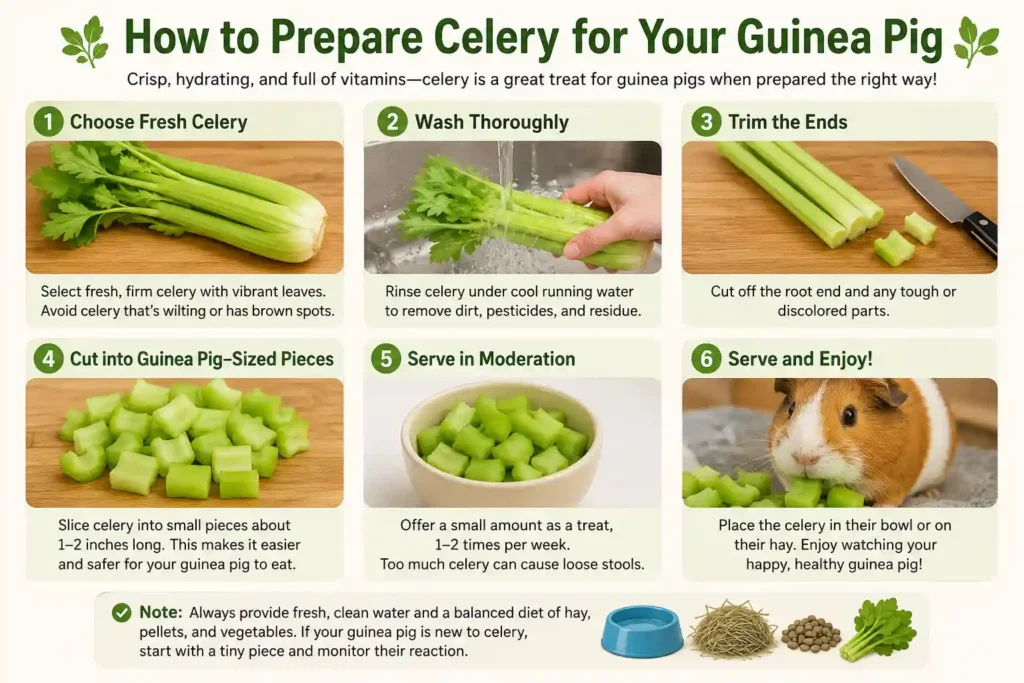
How to Prepare Celery for Your Guinea Pig? (Step by Step)
Prep takes maybe 90 seconds but doing it right is the difference between a safe snack and a real hazard. Here’s exactly what I do every single time.
The moment I pull a fresh celery stalk from the fridge, Mochi wakes up. I don’t even have to say anything. That sharp, clean smell travels fast. She’s at the bars before I’ve put the cutting board down. Every time.
Here’s my step-by-step routine:
- Pick fresh celery. Look for firm, crisp stalks. Deep green color. No yellowing, no limpness, no soft spots. Fresh celery is safer and more nutritious.
- Wash it under cold running water. Celery sits near the top of the dirty dozen pesticide list. Rinse it properly don’t just wipe it on a cloth and call it done.
- Pull off the stringy outer fibers. Run your fingers down the stalk. You’ll feel those tough threads. Peel them away especially if you’re serving a younger or smaller guinea pig.
- Cut into ½-inch pieces. Small chunks only. No long strips. No whole stalks. This one rule prevents most prep-related problems.
- Tear leaves into smaller bits if they’re large. Small pieces are always safer than big ones.
- Serve it fresh. Don’t prep and store for later. Fresh is best, every time.
- Remove uneaten pieces within an hour. Celery wilts fast in a warm cage. Leftover pieces grow bacteria quickly. I do a quick check after every snack session.
That’s the whole routine. Simple, fast, and consistent.
What Parts of Celery Should Guinea Pigs Avoid?
Almost all of the celery plant is fair game, but a couple of scenarios genuinely call for caution.
I’ll be honest. The first time I had people over for dinner, someone joked about dipping a celery stick in ranch and tossing it to Mochi. I said no pretty fast. Your guinea pig doesn’t need ranch dressing. They’re fine. They’re better than fine.
Here’s what to actually avoid:
- Cooked celery. Heat kills the nutrients. It also changes the texture in ways that can upset a guinea pig’s sensitive digestive system. Always raw.
- Seasoned or salted celery. No dips. No sauces. No added anything. A guinea pig’s kidneys are small and fragile. Salt is genuinely harmful to them.
- Wilted or rotting celery. If it’s gone soft and smells off bin it. Don’t serve it. Bacteria grow fast on aging vegetables.
- Long, uncut stalks. Still the most common mistake. Those stringy fibers and the sheer length make them a choking risk. Always cut first.
Fresh. Plain. Small pieces. That’s the rule.
My Guinea Pig Won’t Eat Celery — Is That Normal?
Not every guinea pig is going to fall in love with celery and that’s perfectly okay. These little animals have very strong food opinions. Stronger than you’d expect from something that fits in your lap.