

It was a lazy Sunday afternoon. I was on the couch, eating watermelon straight from the rind like a person with no manners. Then I felt it that stare. My guinea pig, Mochi, locked eyes with me and just waited. No blinking. No mercy. I caved and dropped a small piece into her cage. Then I panic-Googled: can guinea pigs eat watermelon?
If that sounds familiar, you’re in the right place.
The short answer is yes, but the full answer is what actually matters. Based on real cavy owner experience and nutritional data, I’ll walk you through everything. The juicy red flesh, the white rind, the green skin, and those slippery seeds we’re covering all of it. No fluff, no fear. Just honest answers for people who love their weird little potato animals.
Table of Contents
First, the Short Answer (For the Panicked Googler)
Yes. Guinea pigs can eat watermelon. You didn’t poison Mochi. Take a breath.
I remember standing in my kitchen that Sunday, phone in one hand, watermelon rind in the other, genuinely stressed over a two-pound animal who looked completely fine. More than fine, actually. She was doing that happy little nose-wiggle thing. Totally unbothered. Meanwhile, I was in full panic mode.
So here’s the simple truth: watermelon is not toxic to guinea pigs. It won’t send them to the emergency vet. But’ and this is important, it’s not something they should eat every day either.
The biggest concern is sugar. Watermelon is naturally sweet, and that fructose adds up fast for a small cavy. Too much, too often? That’s where the trouble starts. Think weight gain, digestive upset, and a guinea pig who now expects dessert at every meal. (They will absolutely develop opinions about this.)
One more thing before we go deeper the seeds and the rind are a whole separate conversation. Both questions come up constantly, and the answers aren’t as simple as yes or no. Stick around. We’re getting there.
Why Guinea Pigs Go Absolutely Feral for Watermelon
There’s something almost comedic about watching a two-pound animal attack a watermelon slice with zero chill.
The first time I held a small cube near Mochi’s cage, she didn’t sniff it cautiously like a normal creature. She lunged. I pulled my fingers back just in time. The wheek-ing that followed was loud enough to startle my cat in the next room.
But honestly? I get it.
Watermelon hits every note a guinea pig loves. The smell is sweet and fruity cavies have sharp little noses, and fresh fruit basically announces itself. The texture is soft and juicy. No tough chewing required. And that flavor? Pure sugary bliss for an animal whose everyday diet is mostly hay and leafy greens.
It’s also about hydration. Watermelon is roughly 92% water. On a warm summer afternoon, that’s genuinely refreshing for a small herbivore who doesn’t drink as much as you’d think. Think of it as a cold drink and a snack rolled into one.
Then there’s the vitamin C factor. This one actually matters a lot. Guinea pigs, unlike most animals cannot produce vitamin C on their own. Their bodies just don’t make it. Without a steady dietary source, they can develop a painful condition called scurvy. Swollen joints, rough coat, lethargy. It’s as unpleasant as it sounds.
Watermelon isn’t a primary vitamin C source by any means. But every little bit counts as part of a varied cavy diet. Fresh fruit treats like watermelon, paired with vitamin C-rich veggies, help fill that gap.
So yes — there’s real biology behind that dramatic, unhinged excitement. Mochi wasn’t just being theatrical. She knew exactly what she wanted.
Nutritional Breakdown — What’s Actually in Watermelon?
Before you hand over a slice, it helps to know what you’re actually feeding them.
I’ll be honest I never checked the nutrition label on a watermelon before owning a guinea pig. I just ate it and enjoyed it. But after Mochi’s dramatic debut with that first cube, I got curious. So I did what any slightly obsessive pet owner does on a Wednesday night. I actually looked it up.
Here’s what I found.
The Good Stuff
Watermelon has some genuinely solid nutrients. Not life-changing levels, but real ones. Here’s a quick look at what’s inside a small serving:
| Nutrient | What It Does for Guinea Pigs |
| Vitamin C | Prevents scurvy critical since cavies can’t make it themselves. |
| Vitamin A | Supports healthy eyes and immune function. |
| Vitamin B6 | Helps with metabolism and nervous system health. |
| Lycopene | A natural antioxidant supports cell health. |
| Magnesium | Good for muscle and nerve function. |
| Potassium | Supports heart health and fluid balance. |
| Water (92%) | Keeps them hydrated, especially in summer heat. |
The vitamin C entry is the big one. Guinea pigs are one of the few animals alongside humans that cannot synthesize vitamin C internally. Their bodies simply don’t produce it. So they need it from food, every single day. Without it, they develop scurvy. And trust me, you do not want to Google what scurvy looks like in a guinea pig. It’s not pretty.
Watermelon alone won’t cover their daily vitamin C needs. But as part of a varied diet fresh greens, quality pellets, the occasional fruit treat it chips in. Every bit helps.
The lycopene was a fun surprise, honestly. I didn’t expect a cavy snack to have antioxidant properties. It won’t make Mochi immortal, but it’s a nice little bonus.
The Not-So-Great Stuff
Now for the part that made me put the watermelon down and rethink things a little.
- High fructose (natural sugar): Watermelon is sweet. Really sweet. That sugar content adds up fast for a small animal. Regular overfeeding can lead to weight gain and in serious cases diabetes in guinea pigs. That’s not a risk worth taking.
- Low fiber: Compared to leafy greens and hay, watermelon offers very little fiber. Fiber keeps their digestive system moving properly. Fruit doesn’t replace that.
- Loose stools: Too much watermelon too quickly? Get ready for soft, watery droppings. I learned this the hard way during what I now call “The Incident of Last August.” Mochi got a little more than her share one evening. Her cage the next morning was not a highlight.
Think of watermelon like candy for kids. A small piece on a Saturday afternoon? Lovely. A bowl every single day? That’s how you end up at the pediatrician. The same logic applies here.
The treat is fine. The habit is the problem.
How Much Watermelon Can a Guinea Pig Actually Eat?
This is where most owners mess up not maliciously, just because the piggies are SO convincing.
Mochi has a look. I call it the “you’re basically starving me” look. Big eyes. Tiny paws on the cage bars. A soft, pitiful wheek that says I have never eaten a single thing in my entire life. It works every time.
The sweet spot is simple:
- 1 to 2 small cubes — roughly one inch each.
- Once or twice a week — not daily, not every other day.
It sounds stingy. But Mochi weighs two pounds. One cube relative to her size is actually a solid treat. It just looks tiny to us.
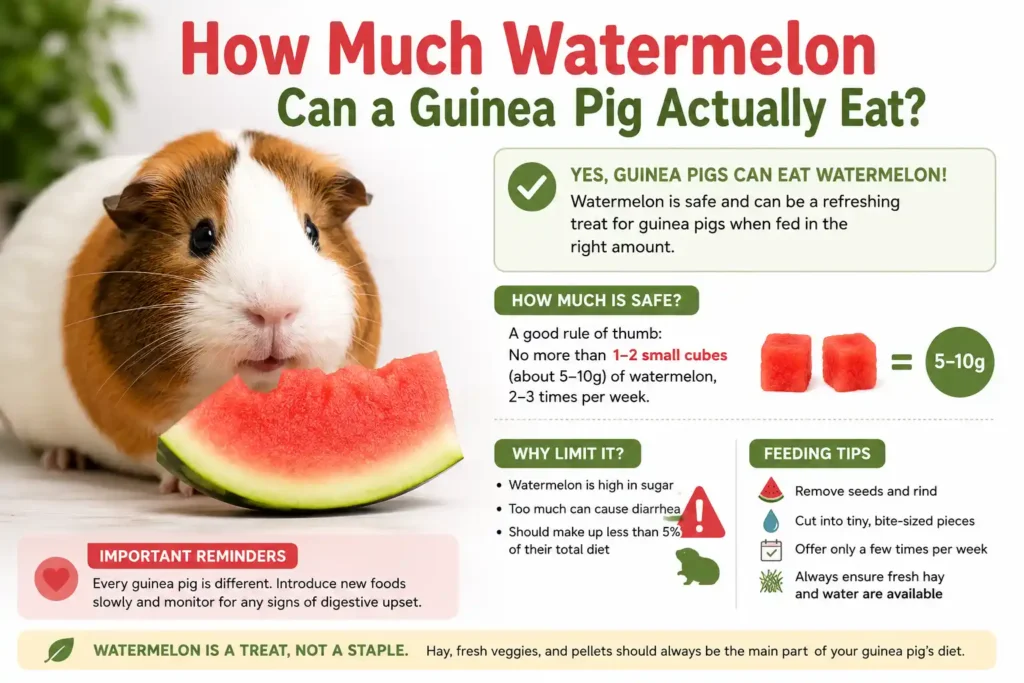
If your guinea pig has never had watermelon before, go slow. Start with one piece. Wait a day and watch. I introduced it on a Tuesday evening one small cube, demolished in forty seconds flat. No issues the next morning. I still waited three days before offering again.
Signs you’ve gone a little overboard:
- Soft or watery droppings.
- Bloating or a puffed-looking belly.
- Less interest in hay a red flag on its own.
- Sluggish behavior, not moving around much.
On treat days, I pair watermelon with cucumber or romaine. Low sugar, added fiber, extra vitamin C. The hay always stays. Always. Fruit is a guest in their diet not a resident.
Can Guinea Pigs Eat Watermelon Seeds?
The seeds question more stressful than it needs to be, but worth knowing.
The first time I cut watermelon for Mochi, I didn’t think about seeds. I just dropped a chunk in. Then I noticed her nudging a black seed with her nose like it personally offended her. That sent me straight back to Google on a Friday night.
Can guinea pigs eat watermelon seeds? No. Remove them first.
Seeds aren’t toxic but toxic and safe are two different things. A hard black seed is a genuine choking hazard for a small animal. Guinea pigs eat fast and don’t always chew carefully when something tastes this good.
Two types to know:
- Black seeds — hard, fully developed. Always remove these before serving.
- White seeds — soft, smaller, lower risk. I still pick them out anyway.
The easiest fix I started buying seedless watermelon specifically for her snack days. Problem solved at the source. No picking through slices on a hot afternoon. No paranoia. Quick, clean, stress-free.
The one rule: If it’s black and hard it comes out. Every single time. No exceptions.
Can Guinea Pigs Eat Watermelon Rind? What About the Skin and Peel?
Okay, this is where it gets genuinely interesting and a little surprising for most owners.
When I first researched whether guinea pigs can eat watermelon rind, I expected a hard no. But I was wrong. One afternoon I accidentally left a strip of white rind in Mochi’s cage alongside the red flesh. She ate the rind first. Just went straight for it. I stood there genuinely confused for about ten seconds.
The White Rind — Actually Fine (and Even Beneficial)
The pale white inner rind is not just safe it’s one of the better parts to offer.
- Lower in sugar than the red flesh less fructose risk overall.
- Contains citrulline a natural amino acid that supports circulation.
- Most guinea pigs love the satisfying crunch.
- Easy to serve in small strips Mochi holds them between her paws.
After that discovery, rind strips became my go-to when I want to give her something fresh without stressing about sugar. Less guilt. Same happy piggie.